Prologue: alternative protein for newcomers
For readers new to the field: what alternative protein is, the main families of technology and how each is made, the general arguments for and against it, where the world stands in 2026 on markets, money and rules, where Vietnam fits, and the terms and conventions needed to read the report.
On this page
In one paragraph. Alternative protein means protein for food or animal feed made from plants, fungi, microbes, algae or cultivated animal cells instead of from livestock and fish. Some of it is ancient (tofu, tempeh, Vietnam's own chay cooking); some is new (precision-fermented dairy proteins, cultivated meat). People promote it for different reasons: food and feed security, efficient use of land and feed, climate, public health, animal welfare and new industries. Each argument has serious counter-arguments, and the market has been through a boom (2019 to 2021) and a sharp correction since. Investment fell below USD 1 billion in 2025 for the first time since 2018, plant milk and familiar foods are holding up better than meat analogues, fermentation took 70% of the money raised in the first half of 2026, and a handful of countries approve new proteins while others ban some of them. This page gives newcomers enough background to read the rest of the report. It adds no new finding about Vietnam.
P.1 Protein, and what "alternative" means
Protein. Proteins are chains of amino acids. The body needs protein for growth and repair, and nine of the amino acids are essential: the body cannot make them, so food must supply them 1 . European regulators set the adult reference intake at 0.83 g of protein per kg of body weight a day 2 . Foods differ in protein quality, meaning how well they supply digestible essential amino acids. The older score, PDCAAS, is capped at 100%; the newer DIAAS, which FAO recommended in 2013, is not capped and scores each amino acid separately 1 . Measured in pigs, soy protein isolate scores a DIAAS of about 97, pea protein concentrate about 70 and brown rice protein about 42, against 113 to 137 for pork; values measured in people can be lower 3,4,5 . Many labels give "crude protein" (nitrogen multiplied by 6.25), which also counts non-protein nitrogen; this matters for microbial proteins, which are rich in nucleic acids.
Where protein comes from today. Animal products supply about a third of the world's protein: 34% from livestock by FAO's count, or 37% including farmed fish in a widely cited global study 6,7 . The rest comes from cereals, legumes, nuts and other plants.
Alternative protein. In this study, alternative protein means protein for food or feed made from plants, microorganisms, fungi, algae, insects or cultivated cells rather than from conventional livestock and fish (R3. Glossary). The definition includes feed on purpose. About 77% of the world's soy is fed to livestock, and only about 6% is eaten directly by people 8,9 . A protein that replaces soybean meal or fishmeal in feed is an alternative protein too.
Novel is a legal word. Many alternative proteins are old. Tofu, tempeh, wheat gluten (mì căn) and Vietnam's chay (traditional vegetarian) cuisine are long-established foods, and chay is still Vietnam's largest plant-protein eating occasion 10,11 . "Novel food" is a regulatory category for foods without a history of safe eating. In the European Union it means a food not eaten to a significant degree in the EU before 15 May 1997, and it needs approval before sale 12 . In Singapore it means a food without a 20-year history of use, and selling one without approval has been an offence since 28 November 2025 13,14 . In the United States many new ingredients reach the market as "generally recognised as safe" (GRAS), a route with no mandatory pre-market approval; the regulator proposed tighter oversight on 10 August 2026 15 . Vietnam has no novel-food category at all 16,17 , which is one reason the report spends time on rules (Rules).
P.2 The families of alternative protein
| Family | What it is and how it is made | Examples and first sale | Where it stands in 2026 | Evidence |
|---|---|---|---|---|
| Plant-based: traditional | Whole or lightly processed legumes and grains: tofu, soy milk, tempeh, wheat gluten | Long established across Asia; tofu holds about 11 g of protein per 100 g in Vietnam's food table | Mature and cheap; the incumbent in Vietnam | 18,19 |
| Plant-based: ingredients | Protein concentrates (about 60 to 80% protein) and isolates (about 90%) extracted from soy, pea, wheat or rice; textured vegetable protein made by extrusion, cooking and shaping under heat and pressure | Widely traded; China is the main supplier to Vietnam | Mature, cheap to make, traded as a commodity | 20,21 |
| Plant-based: analogues | Consumer products that copy meat, milk or eggs, made from the ingredients above; high-moisture extrusion makes fibrous whole cuts | Beyond Burger (2016), Impossible Burger (27 July 2016) | Mature technology; meat analogue sales falling in the US since 2021 | 22,23,24 |
| Fermentation: traditional | Moulds, yeasts and bacteria transform a food: koji mould makes soy sauce and miso; Rhizopus makes tempeh | Long established; soy sauce, miso and Vietnamese tương (fermented soybean paste) | Mature; a skills base for newer fermentation | 25 |
| Fermentation: biomass | A fungus, yeast or bacterium grown in tanks on sugar (or on gases) is itself the protein | Mycoprotein (Quorn, UK, 1985); gas-fermented Solein (Singapore approval 2022); feed protein from steel-mill gas (China, 2021) | Commercial but small; the largest plants are Chinese; some feed plants have halted | 26,27,28,29,30 |
| Fermentation: precision | Engineered microbes make one specific protein, which is purified | Insulin (approved 1982) and cheese rennet (1990) are the precedents; US regulators raised no questions on Impossible's heme (2018; the burger has sold since 2016) and Perfect Day's whey (2020) | Commercial for high-value, low-dose ingredients; too costly for bulk protein so far | 31,32,33,34,35 |
| Cultivated meat and seafood | Animal cells are multiplied in a nutrient medium in bioreactors, sometimes on edible scaffolds | First tasting 2013 (London); first sale Singapore, December 2020 | Approved in a few countries; tiny volumes; high and debated costs | 36,37,28,38 |
| Microalgae and duckweed | Single-celled algae (spirulina, chlorella) or tiny floating plants grown in ponds or tanks | Spirulina supplements; duckweed protein concentrate judged safe in the EU (2023) | Niche; mostly supplements and research | 39,40,41 |
| Insects | Mainly black soldier fly larvae reared on by-products, sold as feed | A 10,000 t a year feed plant has run in Vietnam since 2023 | A benchmark in this report, not a recommendation | 42,43 |
| Blends (hybrids) | Animal protein mixed with plant, fungal or cultivated ingredients | Soy already extends processed meat (31% of one Vietnamese processor's meat recipes list soy protein); Singapore's retail cultivated chicken (2024) was 3% cultivated cells | In the report's reading, the likeliest route for new proteins into ordinary food (Frontier demand) | 44,45,46 |
Making it is the easy part; making it cheaply is the hard part. Each family has a different cost problem (S13. Science, Frontier technology):
- Plant proteins are cheap because they reuse the soy, pea and wheat supply chains; the price of the raw flour or meal decides most of the cost (Economics).
- Biomass fermentation works at scale for feed yeasts and for mycoprotein, but plants are expensive to build. A peer-reviewed cost model puts mycoprotein at about USD 30 per kg of protein, enough to compete with beef but not with chicken 47 . Methane-fed feed protein has struggled: Asia's largest plant, 20,000 t a year in China, halted in 2026 30 .
- Precision fermentation is proven for small, high-value molecules. Bulk food protein would need yields above about 50 g per litre by expert estimates, and the best published heme yield is 10.1 g per litre 35,48,49 .
- Cultivated meat cost estimates differ by an order of magnitude: a model commissioned by a philanthropic funder gives USD 37 to 51 per kg of wet cells and doubts food prices are reachable, while a model commissioned by an advocacy group gives USD 5.66 per kg by 2030 under optimistic assumptions 50,51,52 . The largest reported production run is 20,000 litres 53 .
P.3 Why people argue for alternative protein
Different actors lead with different arguments. In our reading of their documents (Actor check), governments tend to argue security and industry; development agencies, nutrition and resilience; foundations, climate and animal welfare; investors, market size. This report leads with food and feed security, industrial value and trade, and treats the other motives as real reasons some actors hold (How to read). The main arguments, with the best numbers we found:
- Demand for animal products is still rising. OECD and FAO project that calories from meat, dairy, eggs and fish will rise 6% per person worldwide from 2025 to 2034, and 24% in lower-middle-income countries such as Vietnam; output of meat, dairy and eggs rises 17% 54 . FAO projects demand for land-animal products to rise about 20% from the 2020s to 2050 55 . Neither supports the common claim that protein demand "doubles by 2050"; an older FAO projection (2011) of 73% more meat has since been revised down 56 .
- Security and resilience. Brazil and the United States ship about 84% of the world's soybean exports (2024/25; our calculation from USDA data) 57 . Animal disease can remove supply at once: African swine fever killed or forced the culling of about 40% of China's pigs in 2018 to 2019 (as cited), and Vietnam lost nearly 6 million pigs, over a fifth of its herd, in 2019 58,59 . Fishmeal, the premium aquafeed protein, is limited to about 4 to 4.5 Mt a year and reached about USD 2,500 per tonne of fishmeal in August 2026 60,61 . More sources of protein mean fewer single points of failure.
- Land and feed. Meat, farmed fish, eggs and dairy use about 83% of the world's farmland but provide 37% of its protein and 18% of its calories 7 . About 36% of crop calories go to animal feed, and about 12% of those come back as food 62 .
- Climate. Food systems caused about 34% of human greenhouse gas emissions in 2015 63 . For livestock FAO gives two figures: 14.5% (reference year 2005) and, in its latest estimate, about 12% or 6.2 Gt CO2e (reference year 2015); the two use different reference years and model versions, so the lower figure is not evidence that emissions fell 64,55 . Per 100 g of protein, footprints differ widely by food (global averages, chart below).
- Public health. Farm animals received about 99,500 t of antimicrobials in 2020 (a modelled estimate with a wide range, 68,535 to 193,052 t), projected to rise to about 107,500 t by 2030; heavy use feeds antimicrobial resistance 65 . Animals took about 73% of all antimicrobial use worldwide in 2017 (as cited in that study) and about 72% in Vietnam in 2015 65,66 . About 60% of new human infectious diseases from 1940 to 2004 came from animals, though about 72% of those came from wild animals rather than farm animals 67 . The WHO cancer agency classes processed meat as carcinogenic (Group 1) and red meat as probably carcinogenic (Group 2A); the groups rate the strength of evidence, not the size of the risk 68 .
- Animal welfare. At least 86 billion land animals were slaughtered for meat in 2024, 91% of them chickens (our sum of FAO data for seven species) 69 . Estimates for fish, from an animal-welfare advocacy project, run into the trillions but are highly uncertain 70 .
- New industries. Governments frame alternative protein as part of a wider bioeconomy: China's 2022 bioeconomy plan names new foods, and India and Japan set bioeconomy targets for 2030 71,72,73 . These are targets, not outcomes. An advocacy group counts at least USD 2.5 billion of public money for alternative protein worldwide since 2021 74,75 .
P.4 The case against, and the open debates
Each argument above has a serious answer, and readers will meet these in Vietnam:
- Most of what livestock eat is not human food. About 86% of global livestock feed (by dry matter) is grass, leaves, crop residues and by-products people cannot eat 79 . This and the "36% of crop calories" figure measure different things, and both are true.
- Livelihoods. FAO says livestock supports the livelihoods of at least 1.3 billion people 6 . Any shift affects farmers, traders and feed mills first.
- Nutrition. Meat, eggs and milk supply high-quality protein and hard-to-get iron, zinc and vitamin B12, which matter most for young children and pregnant women; more than half of the world's preschool children lack at least one key micronutrient 80 . In low-income countries people are projected to eat only about 143 kcal a day of animal-source food in 2034, below the 300 kcal FAO uses as a healthy-diet benchmark 54,81 . For some people the case is for more animal-source food, not less.
- Processing and health. Plant-based meat products often contain less protein, zinc and vitamin B12 and more sodium than the meat they copy 82 . A large UK study linked plant-based ultra-processed food to higher heart-disease risk, but most of that food was bread and snacks, not analogues; a small trial found lower LDL cholesterol when people swapped red meat for plant-based meat 83,84 . The comparison matters: against processed meats, a Hong Kong survey found plant-based products lower in salt 85 .
- Cultivated meat may not be greener. With pharmaceutical-grade growth media, one peer-reviewed life-cycle study found near-term cultivated meat could emit 4 to 25 times as much as median beef 86 . Its carbon dioxide is long-lived while cattle methane is short-lived, so it is "not prima facie climatically superior" 87 . An industry-informed study finds it beats beef and pork when powered by renewable energy 88 .
- Consumers. In the US, the most studied market, plant-based meat sales fell from USD 1.4 billion (2021) to USD 1.0 billion (2025), and the share of households buying it in a year fell from 19% to 11% (retail scan data published by GFI, an advocacy group) 24,89 . Forecasts made during the boom overshot badly: in 2019 a bank forecast a USD 140 billion alternative meat market by 2029, against USD 6.6 billion of plant-based meat and seafood retail sales in 2025 (a total market against retail sales only, but the gap is still about twentyfold) 90,91 . This report does not use published market-size forecasts as findings (D7. Global benchmarks).
- New dependencies. Alternative protein does not end import dependence by itself. In Vietnam every locally made product with 10 g or more of protein per 100 g already runs on imported textured soy, soy concentrate or wheat gluten, mostly from China 20,21 . A security case needs domestic production, not just a different product (Business buyers).
- Politics. Some governments restrict new proteins: Italy banned cultivated meat in 2023 and Hungary voted a ban in November 2025; eight US states had banned or paused its sale by mid-2026; and the EU will reserve 31 meat words such as "steak" and "chicken" for animal products from 2029, while "burger" and "sausage" remain allowed 92,93,94,95,96 .
P.5 The international landscape in 2026
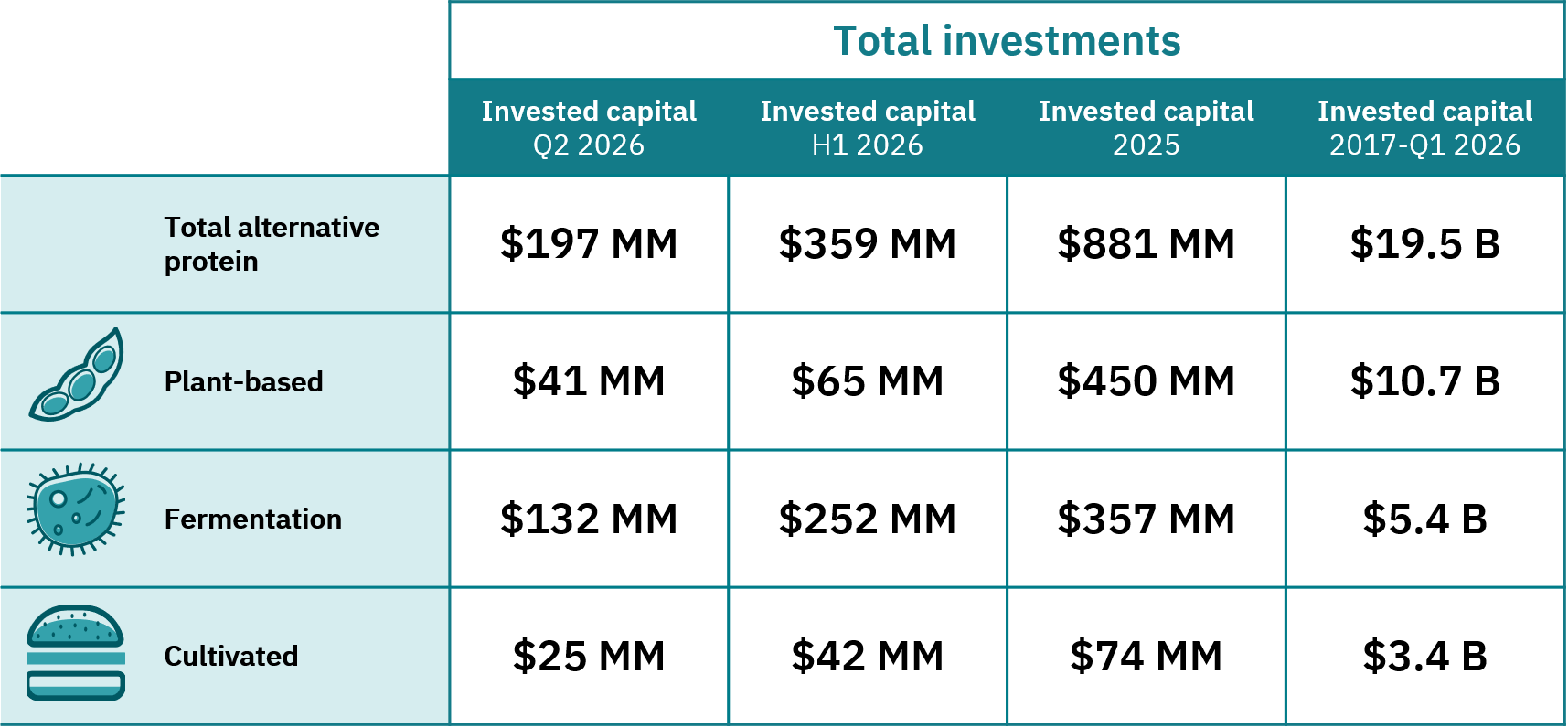
A boom and a correction. The Impossible and Beyond burgers launched in 2016, and Beyond Meat listed on the Nasdaq in May 2019 97,98 . Investment peaked in 2021 at about USD 7 billion (GFI's current series; it reported USD 5.0 billion at the time), fell every year to USD 881 million in 2025, the first year below USD 1 billion since 2018, and was USD 359 million in the first half of 2026 99,100,101,102 . The total since 2017 is over USD 19.5 billion. Money has moved towards fermentation, which took 252 of the 359 million raised in the first half of 2026 102 . The figures come from GFI, an advocacy organisation, using a commercial deal database.
Markets. Retail scan data published by GFI show global retail sales of plant-based meat, seafood, dairy and other categories of about USD 28.9 billion in 2025, up 3%; plant-based meat and seafood were USD 6.6 billion of this, 83% of it sold in Europe and North America 104,91 . Familiar products did better than analogues: plant milk held 13% of US milk sales in 2025 (16% in 2021), and German sales volume of tofu, tempeh and seitan rose 16.7% in 2024 24,89,106 . Beyond Meat's revenue fell from USD 464.7 million (2021) to USD 275.5 million (2025), and it swapped USD 1.1 billion of debt for new notes and shares in October 2025 107,108,109 . Several cultivated and fermentation firms closed in 2024 and 2025, including one that went bankrupt weeks after its US approval 110,53,105 . Asia-Pacific holds over a third of global plant-based dairy sales, but its startups raised little private money in 2025 111,105 .
The US reference case: boom and fade
US retail plant-based meat and seafood: sales (USD billion) and share of total meat sales (%)
SPINS data published by GFI.
Show dataHide data
| Year | Sales (USD billion) | Share of total meat sales (%) | Units (million) |
|---|---|---|---|
| 2021 | 1.4 | 1.4 | 281 |
| 2023 | 1.2 | not reported | 195 |
| 2024 | 1.1 | 0.82 | 194 |
| 2025 | 1.0 | 0.7 | 173 |
Rules. Approvals are concentrated in a few places:
- Singapore had approved 18 novel foods by August 2026, including six cultivated products, from the world's first cultivated chicken (2020) to cultivated beef (2026) 28 .
- The United States has cleared five cultivated products, including salmon in 2025, and sent ten "no questions" letters for fermentation-made ingredients in 2025 38,105 .
- Australia and New Zealand approved cultivated quail in 2025, and Israel cultivated beef in 2024 112,113 .
- The European Union has applications for cultivated products (since 2024) but no approval; it authorised its first mycelium protein in June 2026 114,115,116 . The UK allowed cultivated chicken in pet food (on sale February 2025) and runs a regulatory sandbox 117,118 .
- China approved a mycoprotein and its first ingredient from a genetically modified microbe in 2025 and certified a bacterial feed protein made from steel-mill gas in 2021 119,29 . Korea, Japan and Thailand have routes but no cultivated approval yet 120,121,122 . The regional detail is in S3. Regional.
Public strategies. Some governments fund the field directly: Denmark's plant-based food grant (DKK 675 million for 2023 to 2030), the Netherlands' EUR 60 million for cellular agriculture (2022), and the UK's national alternative protein centre (GBP 15 million, 2024) 123,124,125 . China's 2025 No. 1 Central Document calls for a "diversified food supply system" and new food resources 126 . Others have stepped back: Singapore dropped its "30 by 30" production goal in November 2025 and left alternative protein out of its 2035 targets, and the US revoked its 2022 biotechnology executive order in March 2025 127,128 . Thailand's 2026 to 2035 biotechnology framework names future food and alternative proteins, and Korea's Food Tech Industry Promotion Act took effect in December 2025 129,120 .
Feed. In feed, alternative proteins compete on price with soybean meal (about USD 880 per tonne of protein in August 2026) and fishmeal (about USD 3,846) 61 . China produced about 10,200 t of bacterial feed protein from steel-mill gas in 2023, while insect meal and methane-fed protein plants in Europe and China have struggled 130,30,131 . Fishmeal supply tightened again in 2026 when Peru's first anchovy quota fell 36% 132 .
P.6 Where Vietnam fits
Vietnam is a large producer of meat, fish and eggs built on imported feed protein: it imported 2.61 Mt of soybeans in 2025 (98.4% of supply), and about 99% of the soy protein in its feed is imported 133,134 . It has a strong plant-protein tradition in chay, a large starch industry and amino-acid and yeast fermentation plants, and feed mills that already buy alternative feed ingredients, but no novel-food rules, little pilot capacity and little venture capital (Why Vietnam, Alt protein today). The report's conclusion is that Vietnam's case is a supply case, and that demand pulls new protein mainly as ingredients sold to the firms that already make food and feed (Summary).
P.7 Before you read: terms and conventions
| Term | Meaning in this report |
|---|---|
| Crude protein | Nitrogen content multiplied by 6.25; overstates true protein in microbial products |
| DIAAS | Protein-quality score based on digestible essential amino acids; 100 or more is excellent |
| Concentrate, isolate | Plant protein ingredients of about 60 to 80% and about 90% protein |
| Textured vegetable protein (TVP), extrusion | Dry protein pieces made by cooking protein flour under heat and pressure |
| Biomass fermentation | Growing a microbe that is itself the protein (mycoprotein, yeast, bacterial protein) |
| Precision fermentation | Engineered microbes making one specific protein, such as whey or heme |
| Titre (titer) | How much product a fermentation makes, in grams per litre; a key cost driver |
| Cultivated meat | Meat grown from animal cells; also called cultured or cell-based |
| Novel food | Legal category (EU, Singapore) for foods without a history of safe eating; needs approval before sale |
| GRAS | US route in which a firm, with qualified experts, concludes an ingredient is safe; notifying the regulator is voluntary |
| Blend, hybrid | A product mixing animal and alternative protein |
| Chay | Vietnamese vegetarian practice and cuisine, and the đồ chay products that serve it |
| Soybean meal (SBM), fishmeal | The two main protein feeds; the prices new feed proteins must beat |
| Frontier | The newer routes: biomass and precision fermentation, gas fermentation, cultivated meat and seafood |
| B2B ingredient | A protein sold to firms that already make food or feed, rather than a consumer brand |
| Import substitution, displacement | Replacing imported ingredients with Vietnamese ones, as against replacing meat on the plate; the report counts them separately |
| Scenario (for example S-ALT, D-BENCH) | A labelled future used to test choices, not a forecast (Scenarios 2050, Demand sizing) |
| Play | A specific business or programme someone could start in Vietnam (Plays) |
Units. Mt is million tonnes, kt thousand tonnes, t tonne. The report counts protein and product separately: "19,000 t of protein" is much more product by weight. Money is in USD unless stated, at 26,000 VND per USD. Most claims carry an evidence label and confidence level, and forward-looking and demand claims carry further tags; How to read explains them. The full glossary, in English and Vietnamese, is R3. Glossary.
Sources cited on this page
- PRA-02 Food and Agriculture Organization of the United Nations. Dietary protein quality evaluation in human nutrition. 2013
- PRA-01 EFSA Panel on Dietetic Products, Nutrition and Allergies. Scientific Opinion on Dietary Reference Values for protein. 2012-02-09
- SCI-40 Bailey HM, Fanelli NS, Stein HH. Effect of heat treatment on protein quality of rapeseed protein isolate compared with soy, whey, rice and pea proteins. 2023
- NQR-07 Fanelli NS, Martins JCFR, Stein HH. Pork cuts, hams, and sausages have digestible indispensable amino acid scores (DIAAS) close to or over 100. 2024-08-29
- SCI-42 Shivakumar N et al. Protein-quality evaluation of complementary foods in Indian children. 2019
- PRB-17 FAO. Animal Production. undated (accessed 2026)
- PRB-01 Poore, J.; Nemecek, T.. Reducing food's environmental impacts through producers and consumers. 2018-06-01
- PRA-21 Our World in Data (Hannah Ritchie). Drivers of Deforestation. 2021
- PRA-20 Fraanje W, Garnett T (TABLE / Food Climate Research Network, University of Oxford). Soy: food, feed, and land use change. 2020
- CHY-09 MDPI Sustainability. A Novel Model to Predict Plant-Based Food Choice: Empirical Study in Southern Vietnam. 2020-05-08
- CHY-10 Veredas do Direito. The transformation of traditional Buddhist vegetarianism into a modern lifestyle trend. 2025
- EXP-46 European Commission, DG Health and Food Safety. Novel food. 2026
- EXP-34 Singapore Food Agency. Novel food. 2026-08-27
- REG-63 Singapore Food Agency. Novel Food. 27 Aug 2026
- EXP-45 US Food and Drug Administration. Generally Recognized as Safe (GRAS). 2026-08-10
- REG-01 National Assembly. Luật An toàn thực phẩm 2010 (Law on Food Safety 55/2010/QH12). 17 Jun 2010
- REG-02 Government. Nghị định 15/2018/NĐ-CP hướng dẫn Luật An toàn thực phẩm (Decree 15/2018/ND-CP). 2 Feb 2018
- DIE-12 National Institute of Nutrition. Bang thanh phan thuc pham Viet Nam (Vietnamese Food Composition Table). 2007
- PRA-19 Suhartanti PD, Handajani S, Nandariyah. Physical characteristics of the seeds of soybean (Glycine max) varieties and the effect of fermentation time on the chemical characteristics of tempeh. 2019-05-21
- FORM-01 AltProtein Vietnam. AltProtein Vietnam retail field audit, Nha Trang 6 Sep 2026 and Ho Chi Minh City 16 and 20 Sep 2026, 186 SKUs, 11 stores. 6 to 20 Sep 2026
- TIC-12 United Nations Statistics Division (UN Comtrade). China exports to Vietnam of soy flour, soybean meal, textured protein, gluten and other proteins, 2023 to 2025. 2026
- PRA-12 Impossible Foods. The debut of the world's most anticipated burger. 2016-07-25
- PRA-13 Beyond Meat, Inc.. The Brand New Beyond Burger Launches at Grocery Stores Nationwide. 2021-04-27
- GLB-01 Good Food Institute (data: SPINS, Circana panel). U.S. retail market data for the plant-based industry. 2026
- SCI-19 Frisvad JC et al. Safety of the fungal workhorses of industrial biotechnology. 2018
- PRA-03 Derbyshire E, Theobald H, Wall BT, et al.. Food for our future: the nutritional science behind the sustainable fungal protein, mycoprotein. A symposium review. 2023
- PRA-04 Cheriaparambil R, Grossmann L. Properties and Cultivation of Fusarium spp. to Produce Mycoprotein as an Alternative Protein Source. 2025-02-21
- RGN-04 Singapore Food Agency. SFA list of approved novel foods. 14 Aug 2026
- PRC-30 Chinese Academy of Sciences. 我国首次实现从一氧化碳到蛋白质的合成. 1 Nov 2021
- FTG-06 Feed Business Middle East and Africa. Calysta appoints new CEO as FeedKind producer seeks funding to scale single-cell protein production. 29 Jul 2026
- PRA-10 Sanchez-Garcia L, Martin L, Mangues R, et al.. Recombinant pharmaceuticals from microbial cells: a 2015 update. 2016-02-09
- PRA-07 US Food and Drug Administration (eCFR). 21 CFR 184.1685 Chymosin. 1990-03-23
- PRA-11 US Food and Drug Administration. GRAS Notice No. GRN 000737, agency response letter. 2018-07-23
- PRA-14 US Food and Drug Administration. GRAS Notice No. GRN 000863, beta-lactoglobulin produced by Trichoderma reesei. 2020-03-25
- SCI-01 Nielsen MB, Meyer AS, Arnau J. The Next Food Revolution Is Here: Recombinant Microbial Production of Milk and Egg Proteins by Precision Fermentation. 2024
- PRA-16 Post MJ, Levenberg S, Kaplan DL, et al.. Scientific, sustainability and regulatory challenges of cultured meat. 2020-07-16
- PRA-15 Verbeke W, Marcu A, Rutsaert P, et al.. Would you eat cultured meat?: Consumers' reactions and attitude formation in Belgium, Portugal and the United Kingdom. 2015-04-01
- RGN-03 US FDA. Human Food Made with Cultured Animal Cells Inventory
- PRA-18 Garcia-Encinas JP, Ruiz-Cruz S, Juarez J, et al.. Proteins from Microalgae: Nutritional, Functional and Bioactive Properties. 2025-03-08
- SCI-28 EFSA NDA Panel. Safety of Wolffia globosa powder as a Novel food. 2021
- SCI-30 EFSA NDA Panel. Safety of water lentil protein concentrate from Lemna gibba and Lemna minor. 2023
- ECO-01 Entobel. Entobel Sets Industry Record with the Opening of the Largest Insect Protein Production Plant in Asia. 23 Nov 2023
- ECO-03 Early Warning System database. CnC-Entobel (IFC-46903). 23 Feb 2023
- BUY-05 VISSAN. Vissanmart processed food product pages. accessed 2026-09-24
- NOV-10 Green Queen. Good Meat: Eat Just Debuts Cultivated Chicken in Singapore Retail. 2024-05-16
- NOV-11 FoodNavigator Asia. Hard cell? Expert opinions clash over GOOD Meat's 3% cultivated chicken launch in Singapore. 2024-05-21
- COST-43 Risner D., McDonald K.A., Jones C.E. A techno-economic model of mycoprotein production: achieving price parity with beef protein. 2023
- SCI-02 Nielsen MB, Meyer AS, Hansen K. Enhanced Production of Bovine beta-Lactoglobulin in an Industrial Aspergillus oryzae Host. 2025
- SCI-05 Chen H et al. Integrated Fermentation Engineering Enables High-Level Leghemoglobin Production in Kluyveromyces marxianus. 2026
- COST-47 Humbird D. Scale-up economics for cultured meat. 2021
- SCI-14 Humbird D. Scale-up economics for cultured meat. 2021
- PRA-17 Good Food Institute (reporting CE Delft, commissioned by GFI and GAIA). New studies show that cultivated meat offers massive climate benefits. 2021-03-09
- FTB-24 Good Food Institute. 2026 State of the Industry report: Cultivated meat, seafood, and ingredients. April 2026
- PRB-04 FAO Markets and Trade Division. OECD-FAO Agricultural Outlook 2025-2034: Emerging economies will drive growth in animal-source food consumption and production. 2025-07-15
- PRB-07 FAO Newsroom. New FAO report maps pathways towards lower livestock emissions. 2023-12-08
- PRB-27 FAO Newsroom. Major gains in efficiency of livestock systems needed. 2011-12-14
- QNT-07 USDA Foreign Agricultural Service. Oilseeds: World Markets and Trade. September 2026
- GEO-14 Nguyen-Thi T., Pham-Thi-Ngoc L., Nguyen-Ngoc Q., et al.. An Assessment of the Economic Impacts of the 2019 African Swine Fever Outbreaks in Vietnam. 2021
- GEO-15 Chuong V.D., Schambow R.A., Nguyen D., et al.. Epidemiology and Control of African Swine Fever in Vietnam: A Scoping Review. 2025
- FM-06 Hua, K., Cobcroft, J. M., Cole, A., et al. The future of aquatic protein: implications for protein sources in aquaculture diets. 2019
- FM-01 World Bank. Commodity Price Data (The Pink Sheet). 2 Sep 2026
- PRB-10 Cassidy, E.S.; West, P.C.; Gerber, J.S.; Foley, J.A.. Redefining agricultural yields: from tonnes to people nourished per hectare. 2013-08-01
- PRB-09 Crippa, M.; Solazzo, E.; Guizzardi, D.; Monforti-Ferrario, F.; Tubiello, F.N.; Leip, A.. Food systems are responsible for a third of global anthropogenic GHG emissions. 2021-03-08
- PRB-08 Gerber, P.J.; Steinfeld, H.; Henderson, B.; Mottet, A.; Opio, C.; Dijkman, J.; Falcucci, A.; Tempio, G. (FAO). Tackling climate change through livestock: a global assessment of emissions and mitigation opportunities. 2013
- GEO-25 Mulchandani R., Wang Y., Gilbert M., Van Boeckel T.P.. Global trends in antimicrobial use in food-producing animals: 2020 to 2030. 2023
- MAC-36 Carrique-Mas, J., Choisy, M., Nguyen Van Cuong, et al. An estimation of total antimicrobial usage in humans and animals in Vietnam. 2020
- PRB-12 Jones, K.E.; Patel, N.G.; Levy, M.A.; Storeygard, A.; Balk, D.; Gittleman, J.L.; Daszak, P.. Global trends in emerging infectious diseases. 2008-02
- PRB-14 World Health Organization. Cancer: Carcinogenicity of the consumption of red meat and processed meat (Q&A). 2015 (page accessed 2026)
- PRB-15 Our World in Data; FAO (FAOSTAT). Animals slaughtered for meat. 2024 data (accessed 2026)
- PRB-16 fishcount.org.uk (Mood, A.; Brooke, P.). Fish count estimates. undated (estimates for 2000 to 2019)
- PRB-26 Global Times. China maps out measures to develop $3.28 trillion bioeconomy by 2025. 2022-05-10
- ECF-31 Press Information Bureau, Government of India (Ministry of Science and Technology). India: A Global Bioeconomy Powerhouse. 5 Sep 2025
- ECF-32 Cabinet Office, Japan. Bioeconomy Strategy. 3 Jun 2024
- ECF-43 Good Food Institute. 2026 State of Global Policy: public investment in protein diversification. April 2026
- PRC-05 Cultivated X. GFI's 2026 State of the Industry Reports Detail Mixed Year for Alternative Proteins Across All Three Sectors. Apr 2026
- FUF-07 Our World in Data; Poore and Nemecek. Greenhouse gas emissions per 100 grams of protein. 2019-10-08
- PRB-02 Our World in Data; Poore and Nemecek. Land use per 100 grams of protein. 2018 data (grapher accessed 2026)
- PRB-03 Ritchie, H. (Our World in Data). Less meat is nearly always better than sustainable meat, to reduce your carbon footprint. 2020-02-04
- PRB-11 Mottet, A.; de Haan, C.; Falcucci, A.; Tempio, G.; Opio, C.; Gerber, P.. Livestock: On our plates or eating at our table? A new analysis of the feed/food debate. 2017-09
- PRB-18 UN News. FAO makes case for meat, eggs and milk as 'essential source of nutrients'. 2023-04-25
- PRB-05 OECD and FAO. OECD-FAO Agricultural Outlook 2025-2034: Executive summary. 2025-07
- PRB-21 Harnack, L.; Reese, M.M.; Johnson, A.J.. Are Plant-Based Meat Alternative Products Healthier Than the Animal Meats They Mimic?. 2022-07
- PRB-19 Rauber, F.; Louzada, M.L.C.; Chang, K.; et al.. Implications of food ultra-processing on cardiovascular risk considering plant origin foods: an analysis of the UK Biobank cohort. 2024-08
- PRB-20 Crimarco, A.; Springfield, S.; Petlura, C.; et al.. A randomized crossover trial on the effect of plant-based compared with animal-based meat on trimethylamine-N-oxide and cardiovascular disease risk factors in generally healthy adults (SWAP-MEAT). 2020-11
- PRB-22 Zhang, Q.; Liu, Y.-J.; He, C.; et al.. Nutritional Assessment of Plant-Based Meat Products Available on Hong Kong Market: A Cross-Sectional Survey. 2023-08-22
- FTB-26 Risner, D. et al.. Environmental Impacts of Cultured Meat: A Cradle-to-Gate Life Cycle Assessment. 2024
- PRB-23 Lynch, J.; Pierrehumbert, R.. Climate Impacts of Cultured Meat and Beef Cattle. 2019-02-19
- PRB-24 Sinke, P.; Swartz, E.; Sanctorum, H.; van der Giesen, C.; Odegard, I.. Ex-ante life cycle assessment of commercial-scale cultivated meat production in 2030. 2023-01-12
- GLB-02 Good Food Institute (data: SPINS). 2021 U.S. retail market insights: Plant-based foods. 2022-03
- GLB-44 CNBC (reporting Barclays). Alternative meat to become $140 billion industry in a decade, Barclays predicts. 2019-05-23
- GLB-05 Good Food Institute (data: Euromonitor, SPINS). Analyzing plant-based meat and seafood sales. 2026
- PRC-18 Italian Republic (Gazzetta Ufficiale). Legge 1 dicembre 2023, n. 172: divieto di produzione e di immissione sul mercato di alimenti e mangimi da colture cellulari; divieto della denominazione di carne per prodotti con proteine vegetali. 1 Dec 2023
- PRC-19 Just Food. Hungary bans cultivated meat. 21 Nov 2025
- PRC-16 Council of State Governments Midwest. Updated: Cell-cultured meat remains focus of new laws and legislation across the Midwest. 4 May 2026
- HSC-35 National Agricultural Law Center. Alternative Protein Laws State Compilation. 7 April 2026
- PRC-21 Food Ingredients First. EU 'veggie burger' fight returns as MEPs seek wider naming ban. 27 Aug 2026
- PRC-09 Impossible Foods. The debut of the world's most anticipated burger. 26 Jul 2016
- PRC-08 Beyond Meat, Inc.. Beyond Meat Announces Pricing of Initial Public Offering. 1 May 2019
- HSC-10 Green Queen. Alternative Protein Funding Down by 20% in 2025, Falling Below $1B for First Time in 7 Years. 17 February 2026
- PRC-04 FSR Magazine (reporting GFI). Report: Record \$5 Billion Invested in Alt Proteins in 2021. 2 Mar 2022
- CAP-51 Alternative protein investment. Alternative protein investment, data page. 4 Aug 2026
- PRC-01 Good Food Institute (data: Net Zero Insights). Total investments: invested capital Q2 2026, H1 2026, 2025 and 2017 to Q1 2026, by pillar. 4 Aug 2026
- PRC-02 Good Food Institute. 2024 State of the Industry report: Plant-based meat, seafood, eggs, dairy, and ingredients. Jun 2025
- GLB-06 Good Food Institute (data: Euromonitor). State of the Industry: Plant-based. 2026
- FTB-17 Good Food Institute. 2026 State of the Industry report: Fermentation for meat, seafood, eggs, dairy, and ingredients. May 2026
- GLB-09 GFI Europe (data: Circana, NIQ Homescan). Germany plant-based food retail market insights: 2022 to 2024. 2025-06
- GLB-46 StockAnalysis.com (from company filings). Beyond Meat revenue history. 2026
- PRC-06 Beyond Meat, Inc.. Beyond Meat Reports Fourth Quarter and Full Year 2025 Financial Results. 31 Mar 2026
- PRC-07 Beyond Meat, Inc. (SEC filing). Form 8-K: early settlement of exchange offer for 0% Convertible Senior Notes due 2027. 15 Oct 2025
- HSC-08 FoodNavigator. Cultivated meat's casualties: who is failing and why?. 22 January 2026
- GLB-49 GFI APAC. Korea overtakes Singapore as APAC's cultivated meat startup epicentre. 2026
- RGN-18 Wikipedia. Cultured meat
- RGN-20 GFI APAC. GFI APAC's 2025 Report Card + 6 Things to Watch in 2026. Jan 2026
- PRC-11 EIT Food. GOURMEY files the first EU novel food submission for cultured meat. 29 Jul 2024
- PRC-12 Mosa Meat. Submitting Our First EU Market Authorisation Request. Jan 2025
- HSC-12 vegconomist. Approvals news category (items dated 28 October 2025, 17 April 2026, 4 June 2026, 4 August 2026). 28 October 2025
- PRC-14 Food Manufacture. World's first cultivated meat dog treat goes on sale at Pets at Home. 7 Feb 2025
- PRC-13 FoodNavigator. Inside the success of the cell-cultivated sandbox. 17 Jun 2025
- HSC-11 Keller and Heckman. Year of the Snake, Year of the Horse: China's Food Law 2025 Year-in-Review and 2026 Outlook. 2026
- RGN-21 GFI APAC. Korea overtakes Singapore as APAC's cultivated meat startup epicentre. 21 Apr 2026
- RGN-32 Aleph Farms. Aleph Farms Submits First-Ever Application for Cultivated Meat in Thailand. 5 Dec 2024
- RGN-33 Cultivated X. Japan Releases Draft Safety Checkpoints for Cultivated Meat and Seafood Products. 4 Jun 2026
- VIS-01 Ministry of Food, Agriculture and Fisheries of Denmark. Danish Action Plan for Plant-based Foods. October 2023
- PRC-24 Delft University of Technology. National Growth Fund finances Cellular Agriculture. 15 Apr 2022
- PRC-25 UK Research and Innovation. National alternative protein innovation centre launches. 28 Aug 2024
- PRC-29 CPC Central Committee; State Council of China. 2025年中央一号文件 (Opinions on further deepening rural reform and advancing comprehensive rural revitalisation). 23 Feb 2025
- RGN-08 Ministry of Sustainability and the Environment (Singapore). Oral Reply to Parliamentary Question on Revised Local Production Targets. 13 Jan 2026
- PRC-28 Executive Office of the President (Federal Register). Additional Rescissions of Harmful Executive Orders and Actions. 20 Mar 2025
- RGN-35 NXPO (Office of National Higher Education Science Research and Innovation Policy Council), Thailand. Biotechnology Industry Development Framework B.E. 2569-2578 (Nov 2025; uploaded Apr 2026)
- FTG-22 The Paper (澎湃新闻). 工业尾气如何变身饲料蛋白?. Mar 2022
- AIS-21 The Fish Site. Insect meal: can the sector still deliver on its 2030 promise?. 2025-12-18
- HSC-29 SeafoodSource. Peru extends anchovy fishing suspension again, threatening global fishmeal supply. 12 June 2026
- MAC-04 USDA FAS GAIN. Vietnam: Oilseeds and Products Annual, report VM2026-0006 (Nguyen Linh). 15 Apr 2026
- MAC-09 Bao Ha Tinh. Viet Nam nhap khau 2,61 trieu tan dau tuong nam 2025, kim ngach dat 1,21 ty USD. 8 Mar 2026